Footprints in the Desert – Jackrabbit Homesteaders
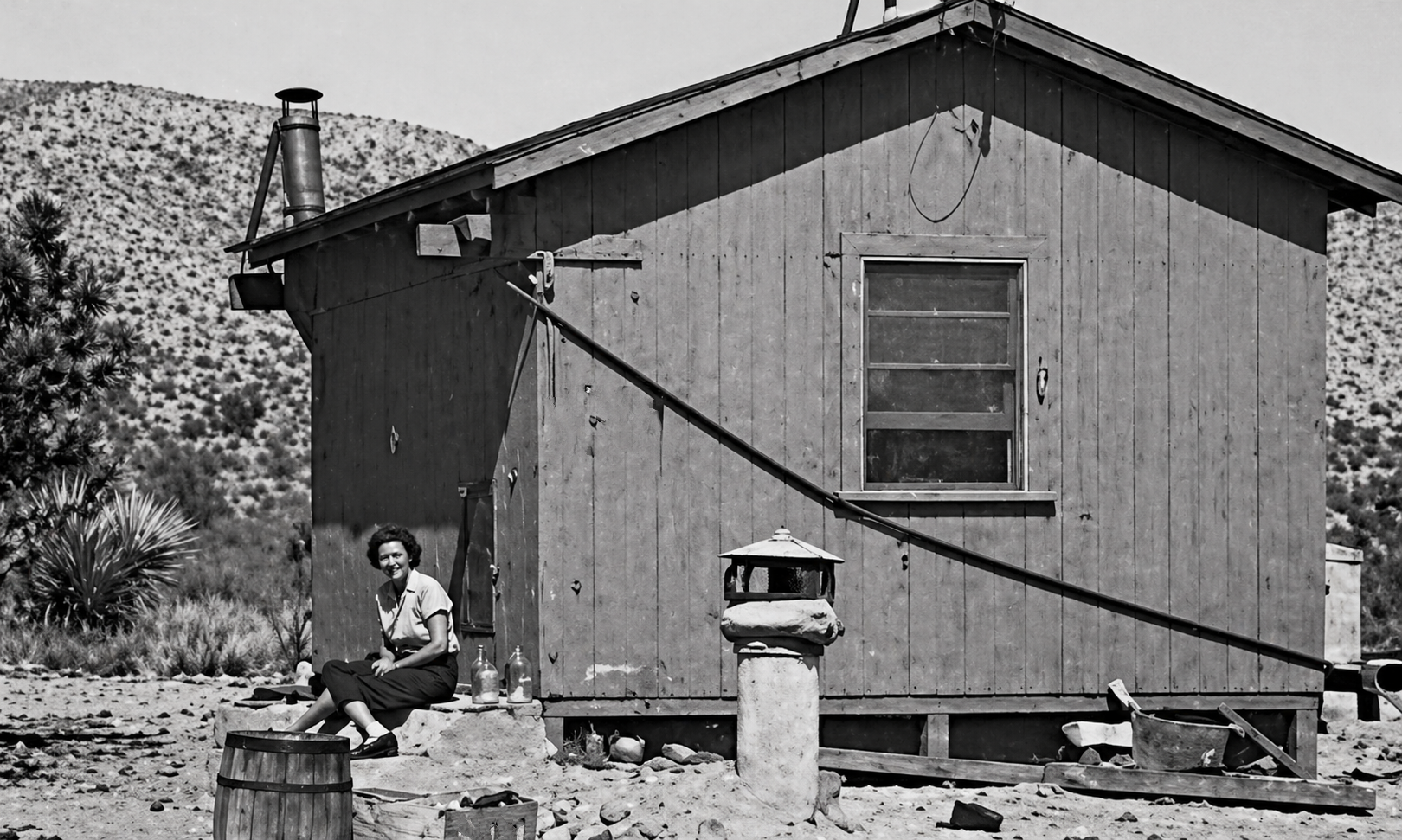
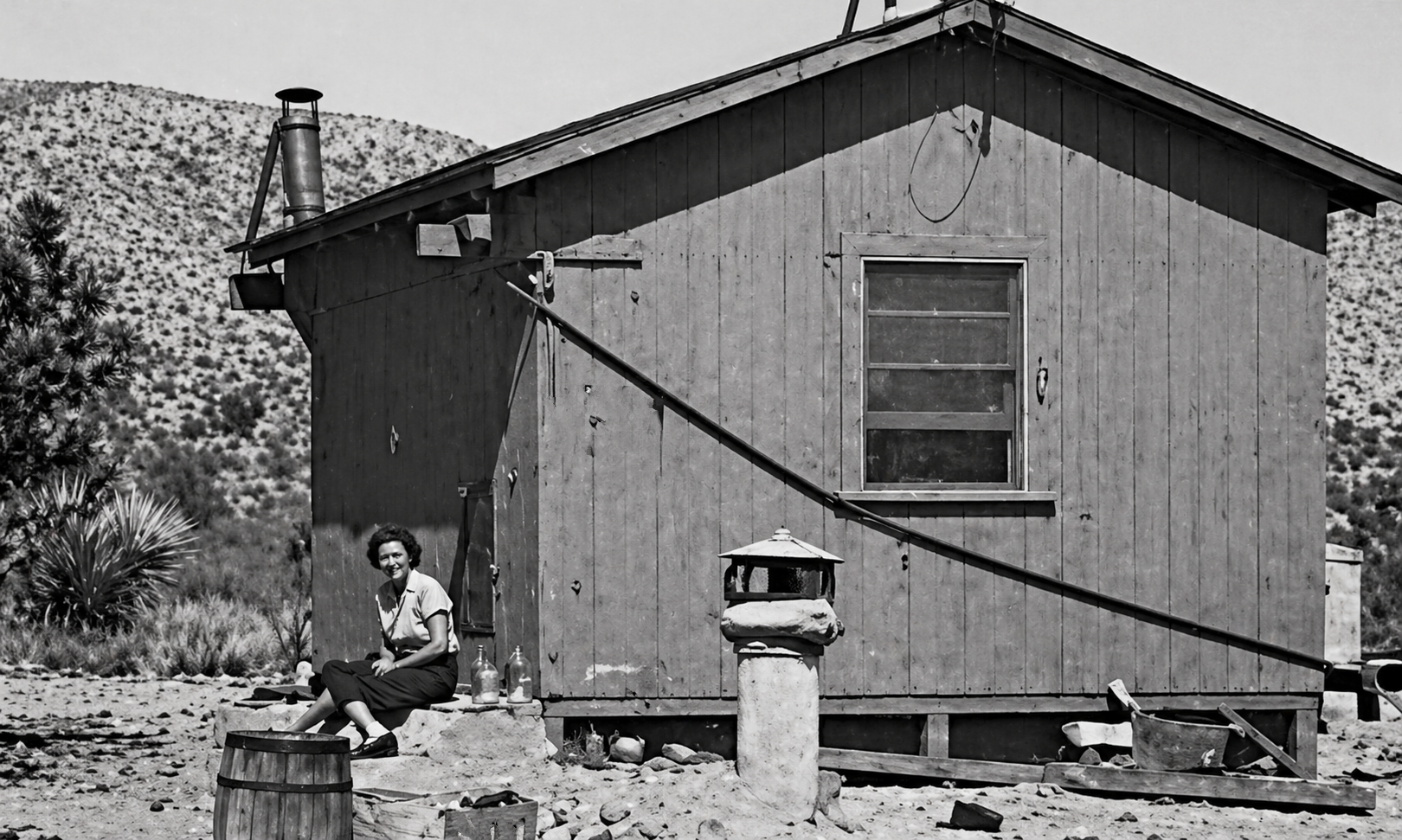
Melissa Branson Stedman was born July 21, 1891, in Texas. In 1920 she married Edward J. Stedman, but they were divorced in 1940. Melissa was a public schoolteacher in Los Angeles, where she resided. She may have had a side occupation as a writer for various magazines because she wrote about her homesteading experiences for Desert Magazine and said she became “infected” with the idea of homesteading while researching and writing an article about Boulder Dam for a British magazine. In 1940, after her divorce, she began her quest to acquire a homestead in the desert somewhere in the Morongo Basin. She died in 1971 at the age of 79. The following are her very colorful accounts of her homesteading adventures as they appeared in Desert Magazine in 1945 and 1949.
Jack Rabbit Homesteader
Land hunger has reached epidemic proportions in these United States. It has broken out like a contagious rash in recent months in Southern California, where hordes of people with a back-to-the-land yearning, swooped down on the U.S. Land Office in Los Angeles in a mad rush for five-acre desert homesteads, anywhere, just so it is earth under foot and space to breathe. Applicants file for any blank space on the map regardless of whether or not it is on a high hilltop, in a dry wash, or the side of a precipitous mountain.
This writer became infected with the malady in its most virulent form in the early 30s while preparing an article on Boulder Dam for a British magazine. I read that California desert land would be opened for homesteading to war veterans in 1939, and to the general public in 1940; so, I patiently sweated it out until that time period. Then to the land office I went for a desert homestead.
I found that the homesteads were for five acres only and were recreation tracts near the Joshua Tree National Monument. They were really not homesteads in the true sense, but were leases of five acres, for five years, at five dollars a year. A five-dollar filing fee was required, and the lease carried a requirement of $300.00 in improvements within the five years as a condition for renewing the lease, or to buying the land in case the government decided to sell.
The purchase part of the deal was only a vague promise by an office clerk in the land office but was good enough for me. I did what nearly everyone else bitten by the land bug does. I made a hasty filing on a blank space on the map for five acres located somewhere near Twentynine Palms, California.
This leap, then look, method proved awkward, for after filing I went to see my land, and what I saw, I did not like. The acreage was in a sandy wash, infested with lizards, beetles and every manner of thing that creeps or crawls. With friends I camped out in the moonlight, anticipating a gorgeous sleep under the stars. But the heat was oppressive, and the bugs were too friendly. They crawled under the covers and kept me awake. I spent a long uncomfortable night with those creeping things of the desert wiggling around inside my pajamas. But I was not discouraged. Somewhere on the desert I would find what I wanted.
Later in the day, we drove into Morongo Valley. The heat was less intense, and while we had left the Joshua trees behind, the landscape was green with yucca and agave and greasewood. I liked this valley and so I hunted up a local “expert” to help me locate the public lands in that area. Finally, we found just what I wanted—nice flat land near the highway, with plenty of vegetation. Back to Los Angeles I went and put in a request to change my original filing to the new location. It was the perfect site for the desert cabin I had dreamed about.
The government sent its engineers out there to put in the corner markers—and the legal description in my possession, and corner stakes to mark the plot, I went out again to take possession of my new rancho. It was a mile away from the site my expert friend had shown me. It was in a boulder-strewn arroyo where there wasn’t enough level ground for a pigeon-roost. I walked miles and miles over the section seeking another location. Then with a compass and a ruler I carefully measured off the distance, figured out the descriptions, and went back to try again at the Land Office. By this time I was feeling a little bit sheepish about asking for still another change of location, but the Land Office was understanding and helpful. I relinquished the claim I held and filed again on the new one. This time I knew that I had what I wanted.
She Saw What Others Missed: Minerva Hamilton Hoyt and the Making of a Desert Park
Not So Fast
126 years ago, on August 18, 1920, Tennessee ratified the 19th Amendment, granting women the right to vote. It came 144 years after the signing of the Declaration of Independence.
But long before that moment, women were already shaping the places around them—often without recognition, and without waiting.
Minerva Hamilton Hoyt was one of them.
She arrived in California at the end of the 19th century, settling in Pasadena with her husband, a physician. By most accounts, she lived the life expected of her—engaged in civic organizations, active in cultural circles, and well connected. She served as president of the Los Angeles Symphony Orchestra and helped support local youth institutions.
The desert was, at first, a retreat.
On trips east into the Coachella Valley and what is now Joshua Tree, Hoyt found something that lingered: a landscape that felt at once spare and complete. It was not lush, not immediately inviting. But it held a kind of order that did not ask to be improved.
Over time, she began to notice it changing.
Desert plants—Joshua trees, cacti, native species that had taken decades to grow—were being removed in large numbers. Dug up, shipped out, replanted elsewhere. Landscapes thinned. In places, erased. What remained did not recover.
The desert, widely seen as empty, was being treated accordingly.
Hoyt’s response was not quiet.
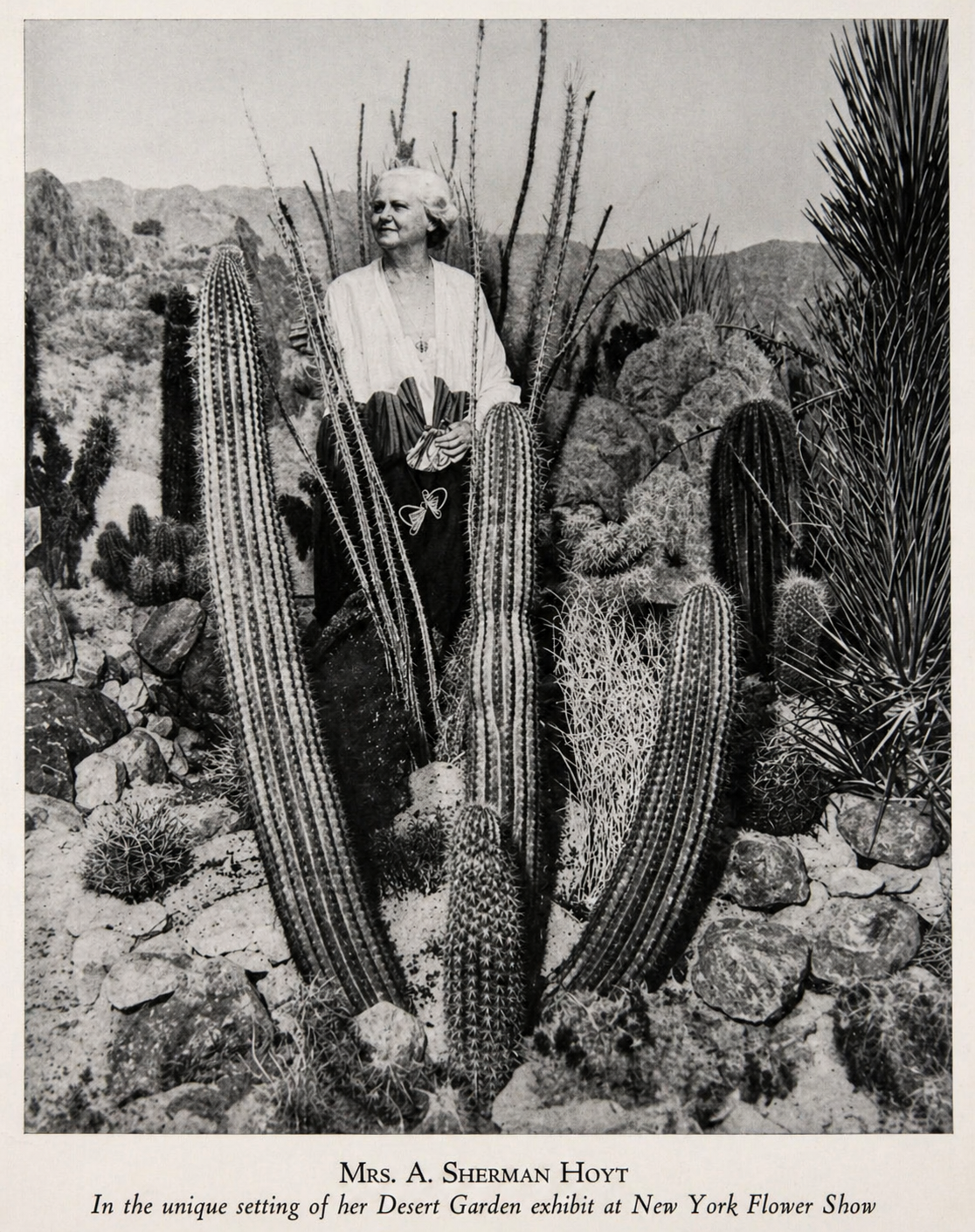
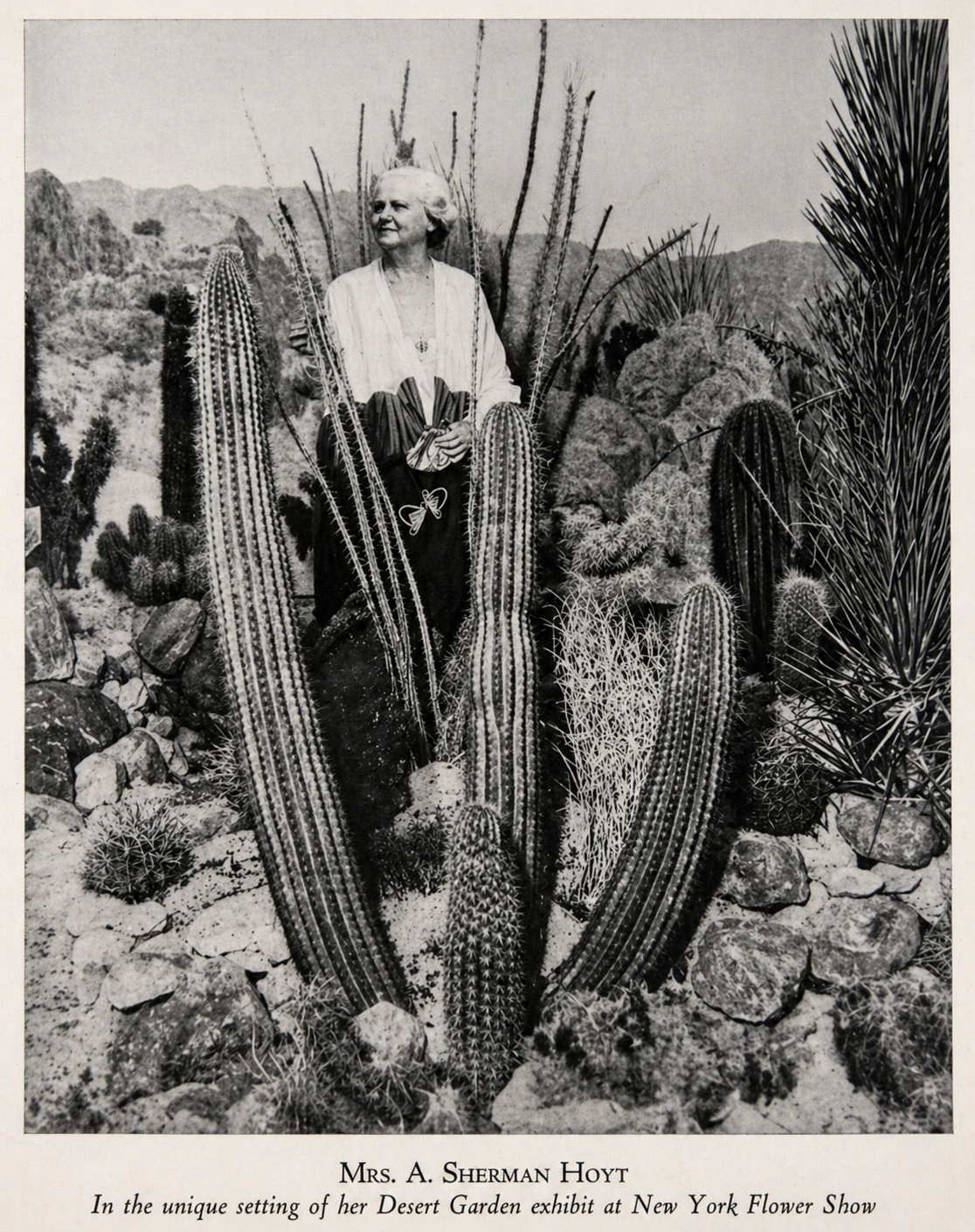
She began organizing, first locally, then nationally. She founded the Desert Conservation League and turned to a strategy that, at the time, was unusual: she brought the desert to people who would never visit it.
In 1928, she arranged for seven freight cars filled with desert plants, rocks, and sand to be transported to New York for a large-scale exhibition. The installation introduced Eastern audiences to a landscape they had largely dismissed. It was, in its way, a reframing.
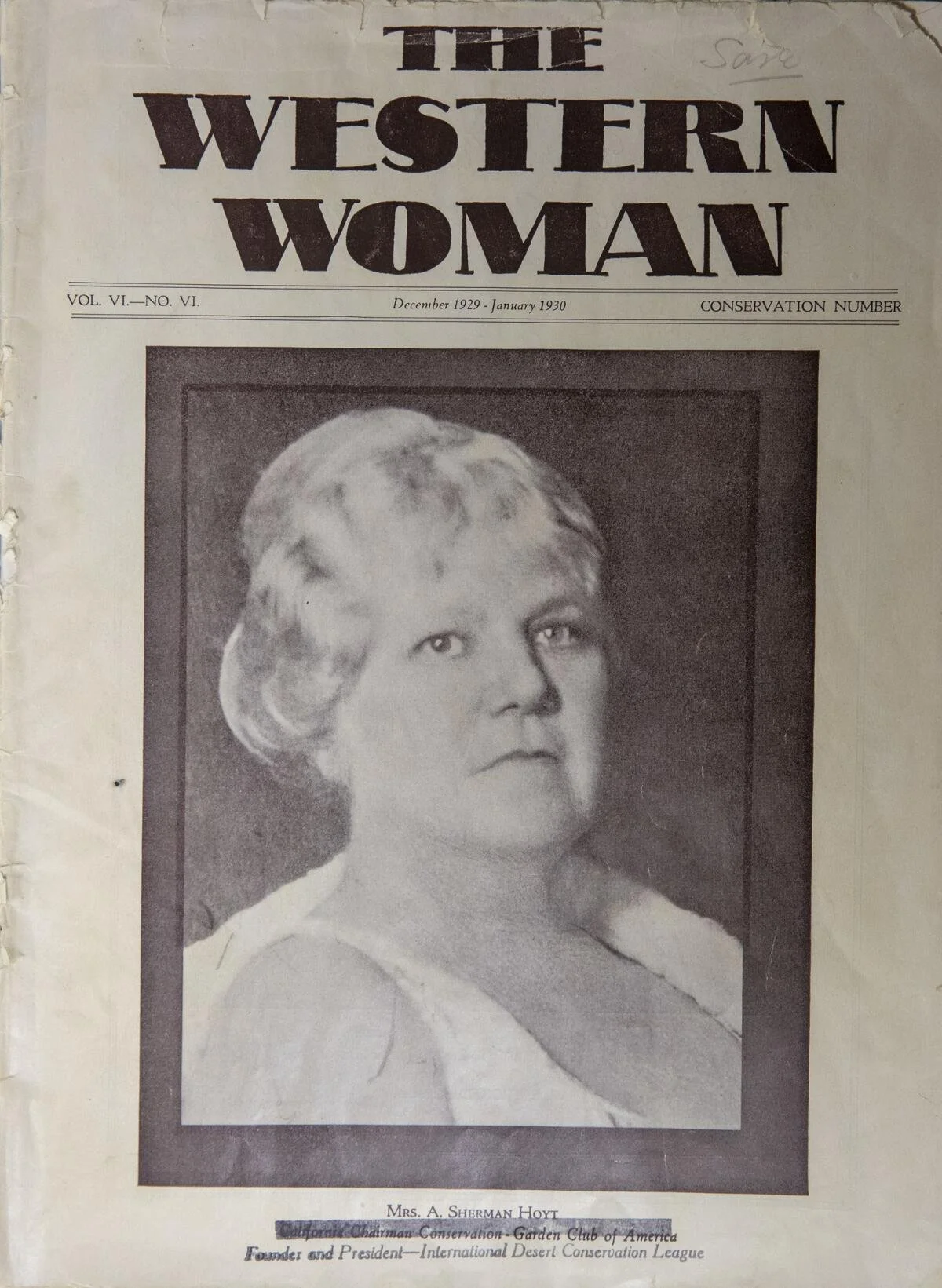
She continued the work abroad, exhibiting in London and helping to push for the protection of desert regions in Mexico. Her efforts there contributed to the preservation of a cactus forest, and earned her a reputation that followed her: the “Apostle of the Cacti.”
But exhibitions were not enough.
Hoyt came to believe the desert required something more durable than awareness. It required designation.
She built alliances with scientists and conservationists, gathered reports, and worked her way through political channels. When she traveled to Washington, D.C., she sought out President Franklin D. Roosevelt. Accounts describe her waiting until she was granted a meeting.
Roosevelt, already interested in expanding the national park system during the New Deal, was receptive.
On August 10, 1936, he signed a proclamation establishing Joshua Tree National Monument.
The designation did not transform the landscape. It did something more subtle. It changed how the land would be treated going forward.
Hoyt continued her advocacy in the years that followed, but much of what she set in motion outlived her.
Her name now appears on the Minerva Hoyt California Desert Conservation Award, presented by the Joshua Tree National Park Association. It is given to those who continue the work of protecting desert environments—work that, by its nature, is never finished.
The pressures have changed. The landscape has not.
What Hoyt recognized nearly a century ago—that the desert’s apparent emptiness makes it vulnerable—remains true.
Preservation, then as now, depends on whether someone is willing to see what others overlook, and act before it disappears.
First Landers Post Office Proudly Remembered Almost 66 Years Later
The Post Office has been with us as a country from the very beginning of the Republic. It traces its beginnings back to 1775 during the Second Continental Congress, when Benjamin Franklin was appointed the first postmaster general. The Post Office Department was created in 1792 with the passage of the Postal Service Act and Congress was given the authority in Article 1 Section 8 of the Constitution to establish post offices and postal roads.
In a 1954 National Geographic article, then-postmaster Arthur E. Summerfield put the importance of the Post Office this way: “It is ... the greatest as well as the most economical of all the social services in our modern society. No other agency of government is so close to the daily life of each community or so personal in its relations with our people.”
The Post Office is, according to most surveys, the most popular governmental agency with a favorability rating of 90 percent or better. The fact is most citizens have continuous daily contact in one way or another with their local post office. The story of the Landers Post Office illustrates how important it was to Landers and the other surrounding homestead communities.
In the 1950’s Landers grew mainly as an area of recreational homes for part-timers and weekenders encouraged by the government’s passage of the 1938 Five-Acre Homestead Act known as the “Jackrabbit or Baby Homestead Act.” Mail was delivered on a Star Route to about 42 mailboxes. However, permanent residents who had postal boxes had to drive into Yucca Valley to pick up their mail since Landers did not have its own Post Office.
It was Newlin Landers who first attempted, unsuccessfully, to persuade the government to establish a post office in Landers. In 1959, Vernette Landers took up the effort. She had the help of Congressman Harry R. Sheppard. “Congressman Shepherd said, well, he wanted to be sure that I was serious about this matter. So, he said, ‘If, you will find land with a building on it and agree not to put any other business on it, and you will take charge of that post office for 10 years at $1 a year, then I will try to help you get a post office.’”
“He did what he said he would do and Hilda Hardesty, who was the postmaster at Yucca Valley, helped me start the Landers Rural Station out here in Landers. First, I had to get the building, and across Reche Road from where we lived, the Kelley’s were living in an old desert cabin. It was built by a man named Klingbeil in 1958 as a recreational cabin. It had no plumbing or anything like that. There was a privy outside. I was able to purchase it from the Kelleys because they wanted to leave the area and it made a perfect spot for the Landers Post Office,” said Vernette in an interview.
Vernette Landers was awarded the contract to operate the station (post office) for $1 a year. Dedication Day was February 2, 1962 and it officially opened with 170 mailboxes of which 160 were rented by permanent residents. By 1984, more than 500 boxes were rented.
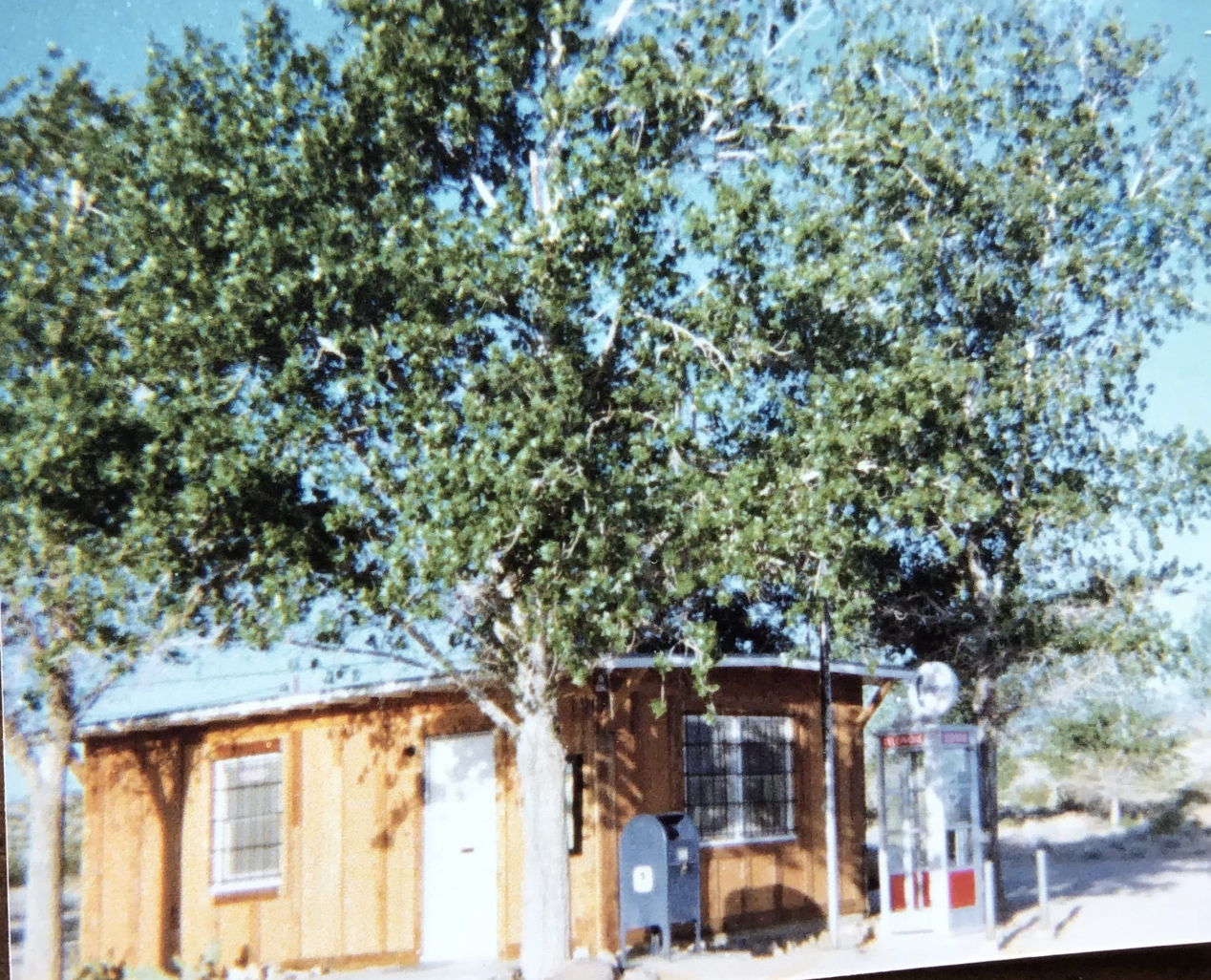
Mary Chessey was Vernette’s first assistant and she worked there for ten years, retiring in 1972. Virginia Deshon, who put in 20 years at the post office, became the Assistant Postmistress. Judith Deshon, her daughter-in-law, also worked there until 1985. Vernette paid for all of the operating expenses including the salaries. When she wasn’t working her full-time job with the school district, she clerked in the post office. She kept up a continuous correspondence with the postal service and other governmental agencies and officials on a range of issues. Finally, she retired from the post office in 1985 and donated the land and the building to the United States Postal Service.
Landers was the first post office to be granted in an area of government recreational tracts. The approximate 400 sq. ft. wood cabin was divided into two tiny interior parts with slightly over half allotted for postal work and the balance dedicated for public access to mailboxes and other services. It soon became a center of community life. Many locals can remember waiting outside the little Post Office visiting under the trees there. Others gathered under the cottonwoods across the road where they would socialize and fill their jugs from the faucets there. Often this is where plans were made to meet again for Friday Night “Cook Your Own Steak” and dancing at the Longhorn or Belfield. Hall.
Don and Judith Deshon remember the post office very well. Don’s parents, Otis and Virginia Deshon first came out weekends with their children beginning in 1948. Don was 12 years old at the time and helped his dad build their first homestead cabin. His 5th grade teacher in Bell Gardens was Vernette Landers. Later on, after he grew up, he put in a lot of work with Newlin Landers, helping him with his water service and other businesses. He remembers grading Reche Road with a grader attached to Newlin’s World War II surplus weapons carrier. (Both the grader and carrier are on display at the Morongo Basin Historical Society’s museum grounds in Landers.)
Judith Deshon has many memories from working at the Landers Post Office. All the postal records were carefully kept in spiral notebooks. It was the friendliest place. Folks exchanged cookies, candy, food. One person went to Hawaii every year and sent them macadamia nuts.
One time they received a letter, postmarked from a town in Pennsylvania, addressed in childish writing “To Grandma and Grandpa, Landers.” The postal staff asked everyone who came in if they had grandkids living in Pennsylvania. It took a while but they finally figured it out and the letter was delivered to the grandparents in Landers in time for Christmas.
If old people came in and they couldn’t bend down to get mail from their boxes, the staff helped them out. They often received mail with no box numbers in the address lines and they made every effort to figure out who it was intended for without returning it.
Don said the post office was a “godsend” for the homestead communities since the residents could pick up the mail in Landers instead of driving 16 miles to Hardesty’s store in Yucca Valley where Hilda Hardesty the Post Mistress ran the post office. Don remembers whenever Newlin drove to Yucca Valley, “Talkie” the Landers’ pet raven rode on the hood ornament of the car partway before flying back home to 632 Landers Lane.
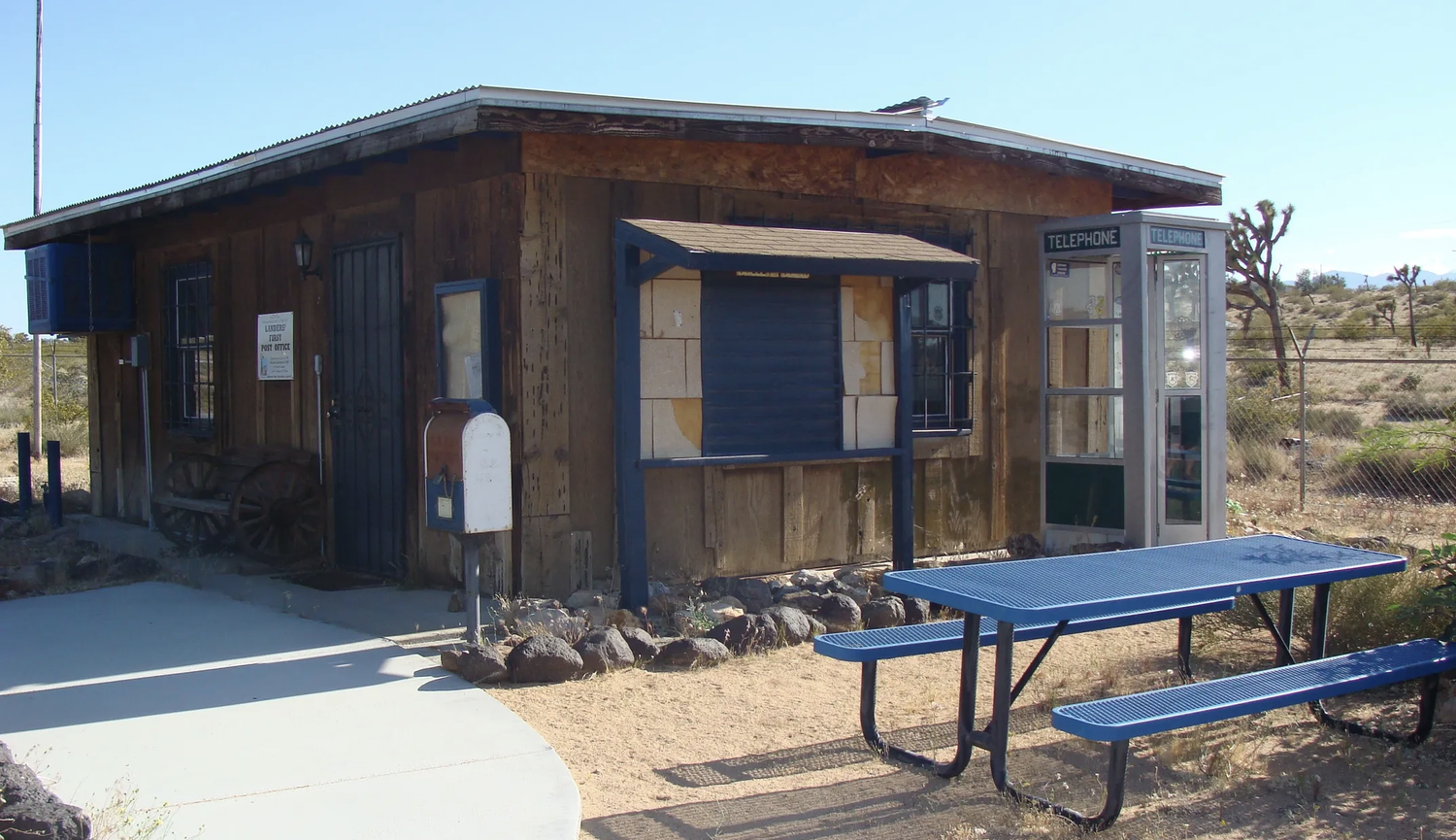
Don always wanted to turn the homestead cabin across from the Post Office into a donut and coffee shop. He supposed he’d be a rich man because the patrons hung around the post office gossiping all day.
Judith remembers how Vernette’s tenure at the Post Office was ended abruptly. On December 8, 1985, Vernette asked for raises for the employees. A post office official came out and said “as today, you are no longer needed.” So, they kicked Vernette out.
In 1997 ground was broken for a new post office. The opening ceremony was May 4,1998. Shortly thereafter, the postal service deeded the original cabin back to Vernette and she was then faced with moving it to her property at 632 Landers Lane, about a half-mile south of its location. During 1998 and 1999 the original post office building was dismantled and moved to her home on Landers Lane where it was reassembled. Today this building still stands on the grounds of the Morongo Basin Historical Society’s Museum and Research Center. It contains many original items from the old post office such as the safe, cancelled stamps, photographs, letters and old business records.
In August, 1999, the California Office of Historical Preservation, through the efforts of the Morongo Basin Historical Society, designated the original post office as a California Historical Resource and in 2000 a commemorative plaque was installed.

Evelyn Grace Conklin: A Trailblazer in Nature Conservation and Community Enrichment (March 29, 1927 - July 2, 2024)

The Trailblazer
Evelyn Grace Conklin, 97 years young, passed peacefully on July 2, 2024, to join her family and friends waiting to welcome her to the Lord’s Kingdom. Evelyn, a life-long nature lover, was well known and admired by many in Yucca Valley as founder and first curator and naturalist of the Hi-Desert Nature Museum. From 1964 until she retired in 1992, Evelyn managed the popular museum, with its many live animals and reptiles, where parents knew their children were in a safe and learning environment.
Although she was intent on it becoming a nature museum, Evelyn recognized the opportunity to serve other community needs and to cultivate groups and individuals who would aid and support the museum. She opened the museum for local and visiting artists to display their works. Each month a different artist was selected as artist of the month and the museum would hold a reception to introduce each one. Between 1967 and 1973, the museum showed over 2,000 pieces of art by 135 different artists. As a result of this exposure, the art community became one of the museum’s strongest boosters. Not only did artists sometimes donate one or more of their artworks, but they also contributed their time, money, and influence to keeping the museum operating.
Under Evelyn’s guidance, the museum developed a wide variety of specialized displays and exhibits. She encouraged the participation of local groups such as the Morongo Basin Gem and Mineral Society and the China Painters’ Club to create displays for the museum. Other special interest groups as well as individual hobbyists offered their collections of metal works, dolls, or wood carvings for museum exhibits.
Evelyn became such a respected naturalist and museum curator that every year Caltech came to the Hi-Desert Nature Museum with visiting professors from all over the world. Conklin also advised and was responsible for starting the Santa Barbara nature museum and four other natural history museums in California. While running the museum, she honed her administrative skills. She even brought her own typewriter from home to save money on a tight budget.
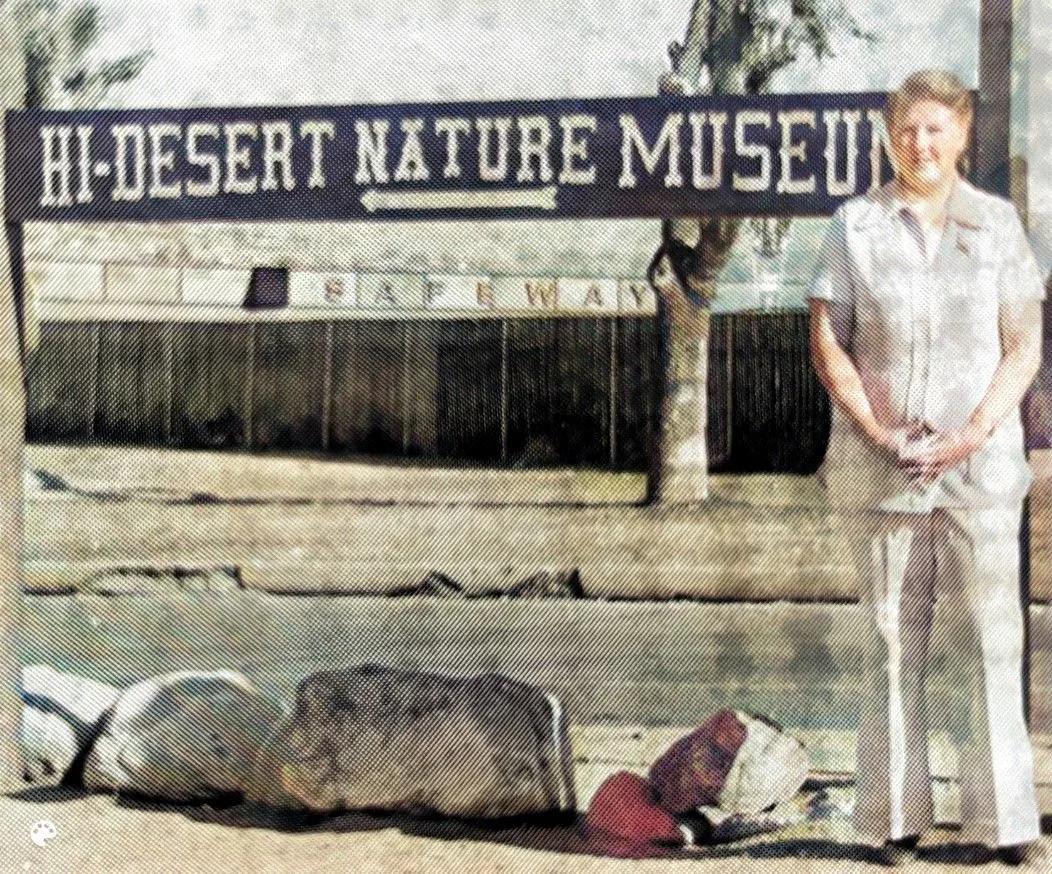
The Hi-Desert Nature Museum opened its doors in a small building in Hi-Desert Park (now Jacobs Park) on Onaga Trail in October 1964, although the actual Grand Opening was held on January 21, 1965. Evelyn served as curator-naturalist for 28 years, retiring in 1992. The museum was popular from the beginning. Almost 1,000 visitors showed up in the first month at the Onaga Trail location. The museum rapidly became a local tourist attraction. By 1989, when it added the diorama wing, there were more than 30,000 visitors annually from all fifty states and dozens of foreign countries.
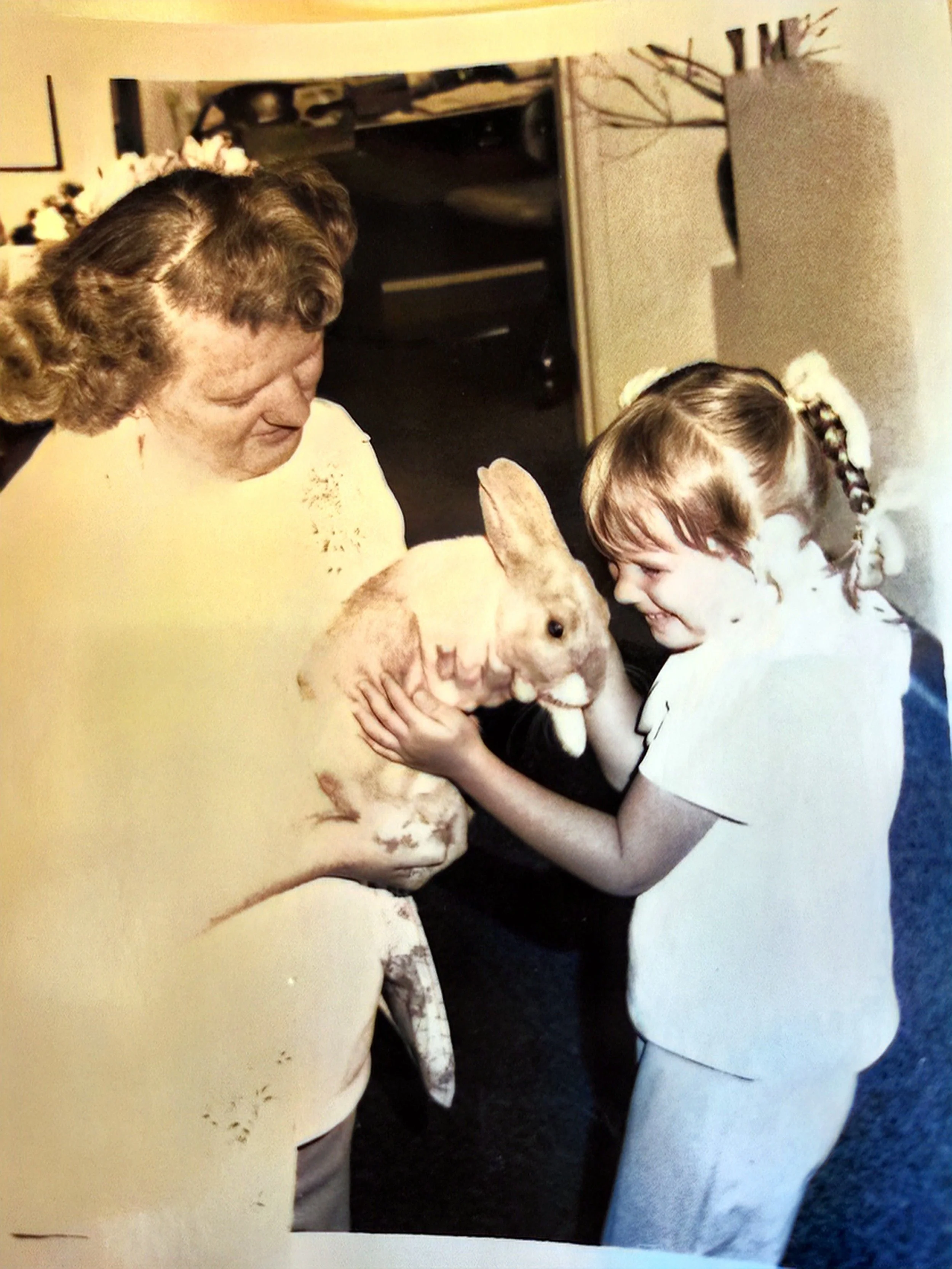

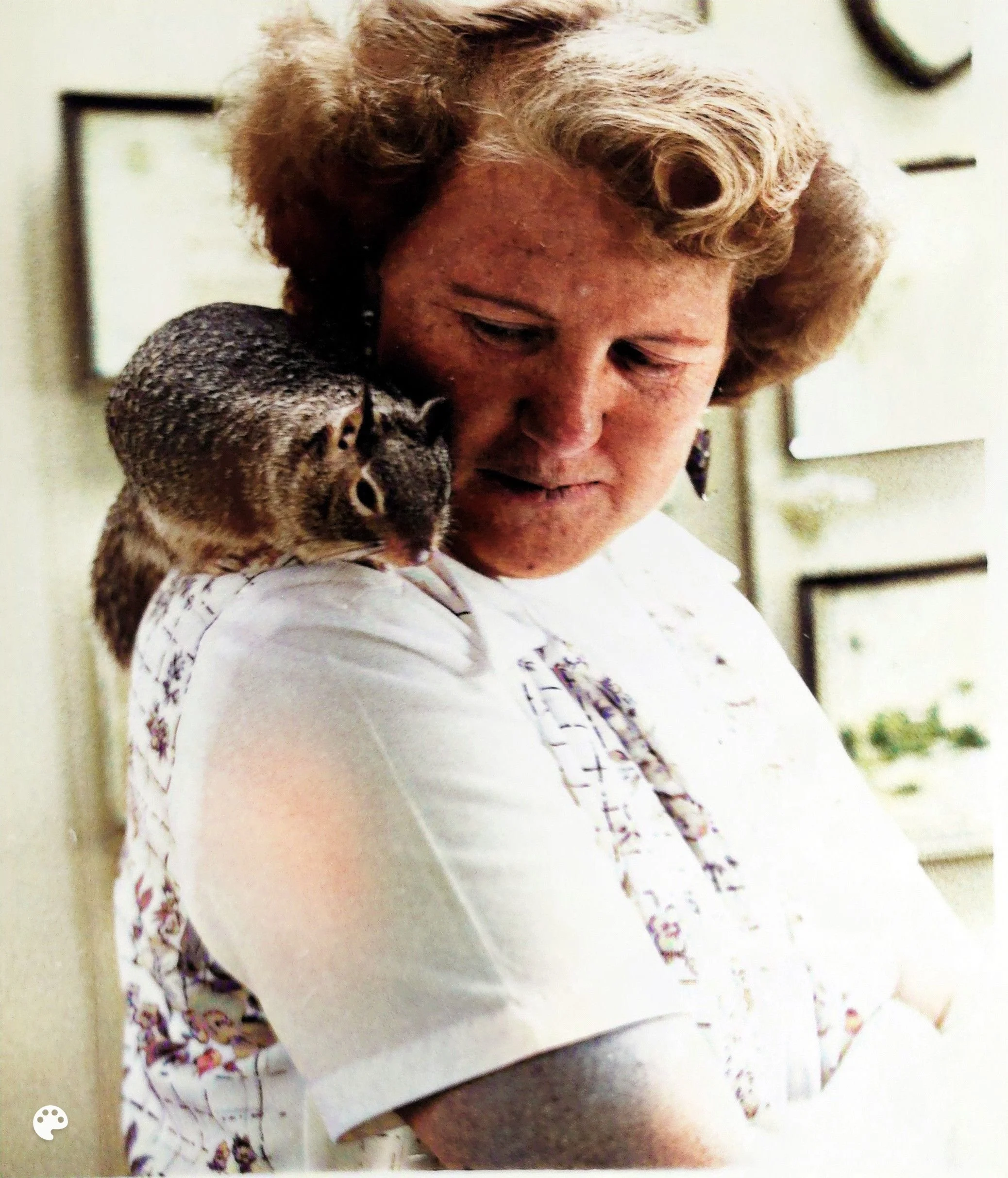
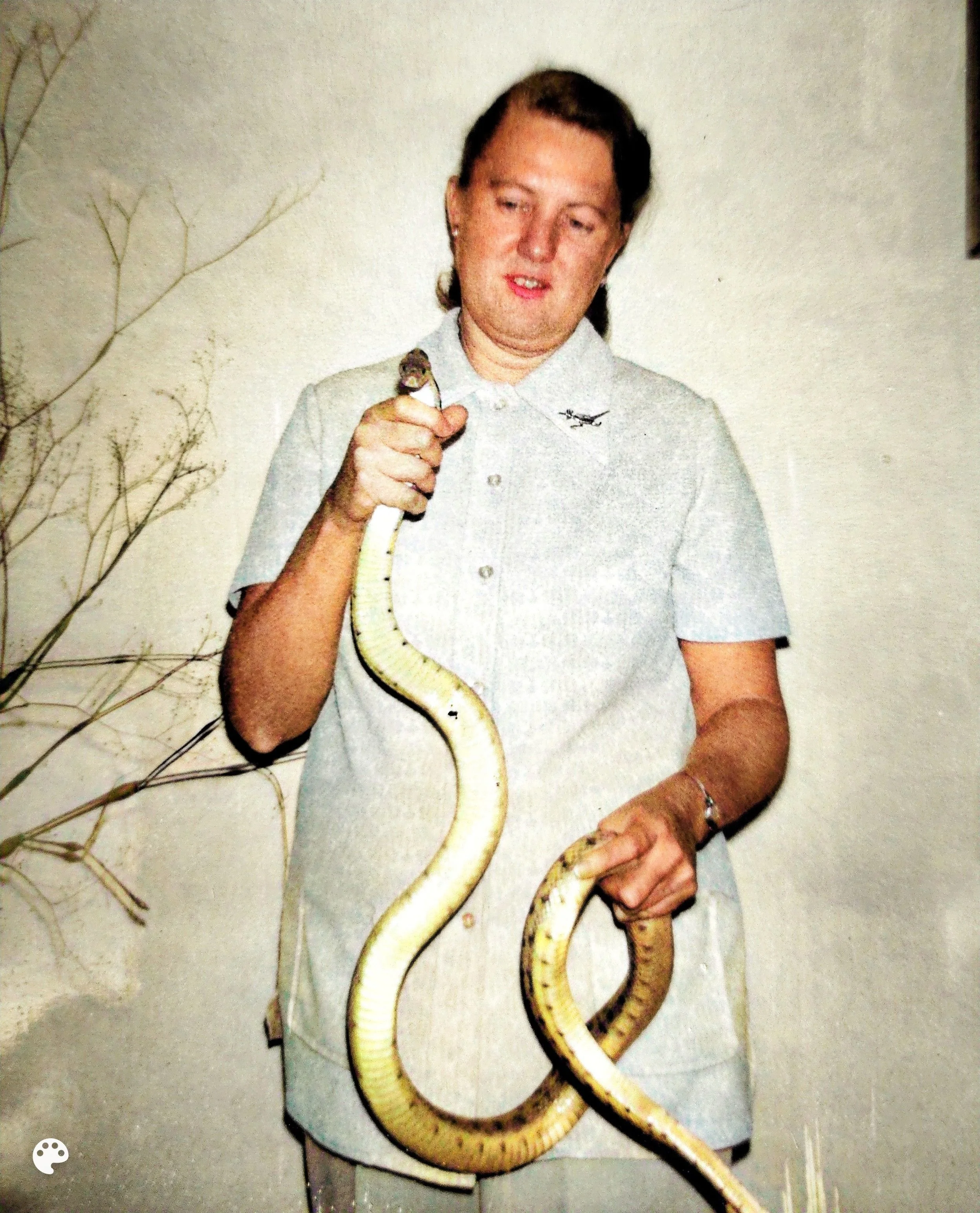

By 1972, the museum had begun to outgrow its 800-square-foot space and Evelyn was forced to hang some exhibits from the ceiling. Subsequently, in 1973, the museum was relocated to a 3,200-square-foot space in the brand-new Yucca Valley Community Center. Then, with the help of loyal volunteers, they moved everything to the new museum using their own vehicles and at their own expense. It was in the new museum building that Evelyn was able to realize her vision of having a nature museum with live exhibits of snakes, lizards, and small mammals.
In addition to professional recognition, Evelyn was awarded a plaque of appreciation by the Yucca Valley Chamber of Commerce in 1966-67; was made the first Honorary Life Member of the Yucca Valley Art Association in 1974; and was named Woman of the Year by Soroptimist International of Yucca Valley, in 1976. In 1990, Evelyn was honored as Grand Marshal of the Grubstake Days Parade.
Perhaps the greatest honor that Evelyn and the museum received came during a budget crisis when the city was considering cuts in hours and staff. During a town meeting to discuss the options, the kids stood up and pleaded for the museum and dug into their pockets and emptied their piggy banks of pennies, nickels, and dimes to keep the museum going.


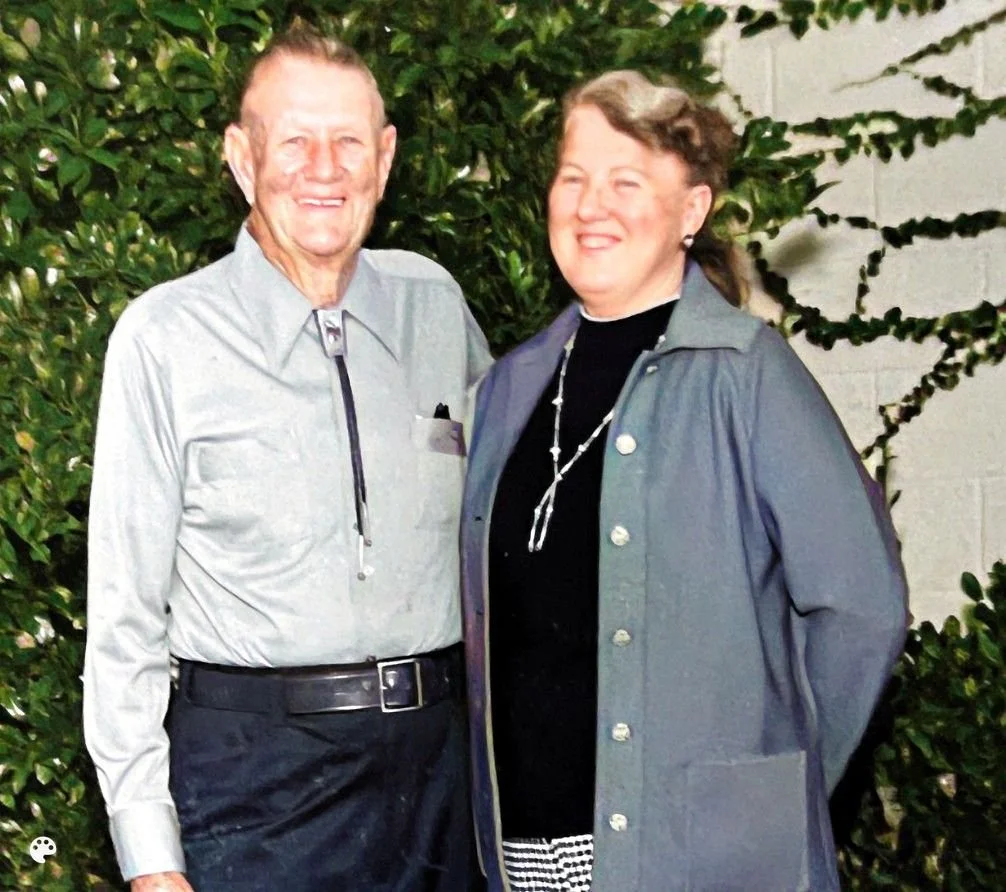
Evelyn and her father, Percy ‘Slim’ Conklin, moved to the Morongo Basin from San Dimas not long after Slim retired from the Los Angeles County Parks and Recreation Department. Evelyn had been raised by her father since her mother Edith died in 1945. In 1948, with her father’s recommendation, Evelyn, age 21, was hired to start the first nature museum in California.

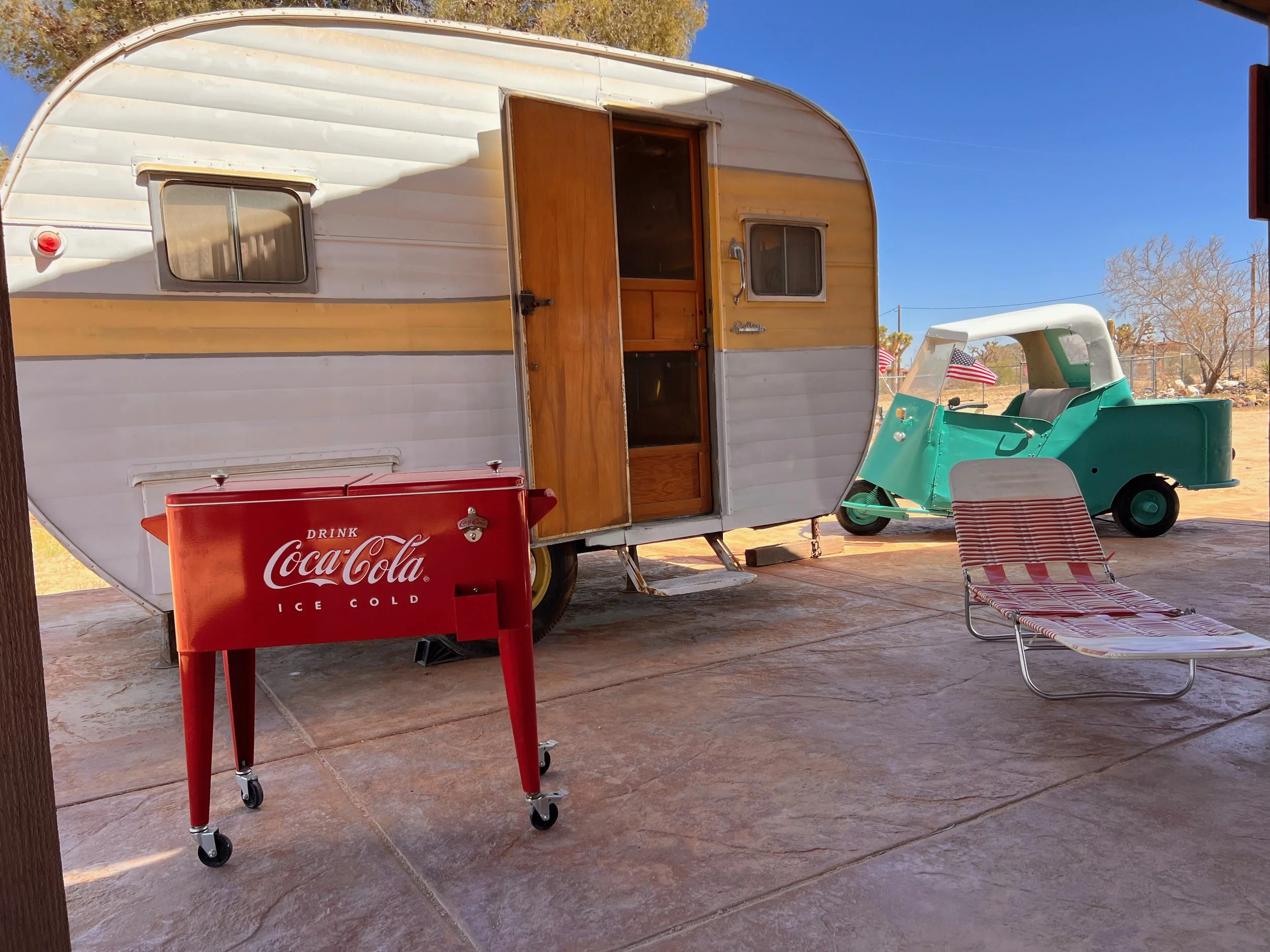
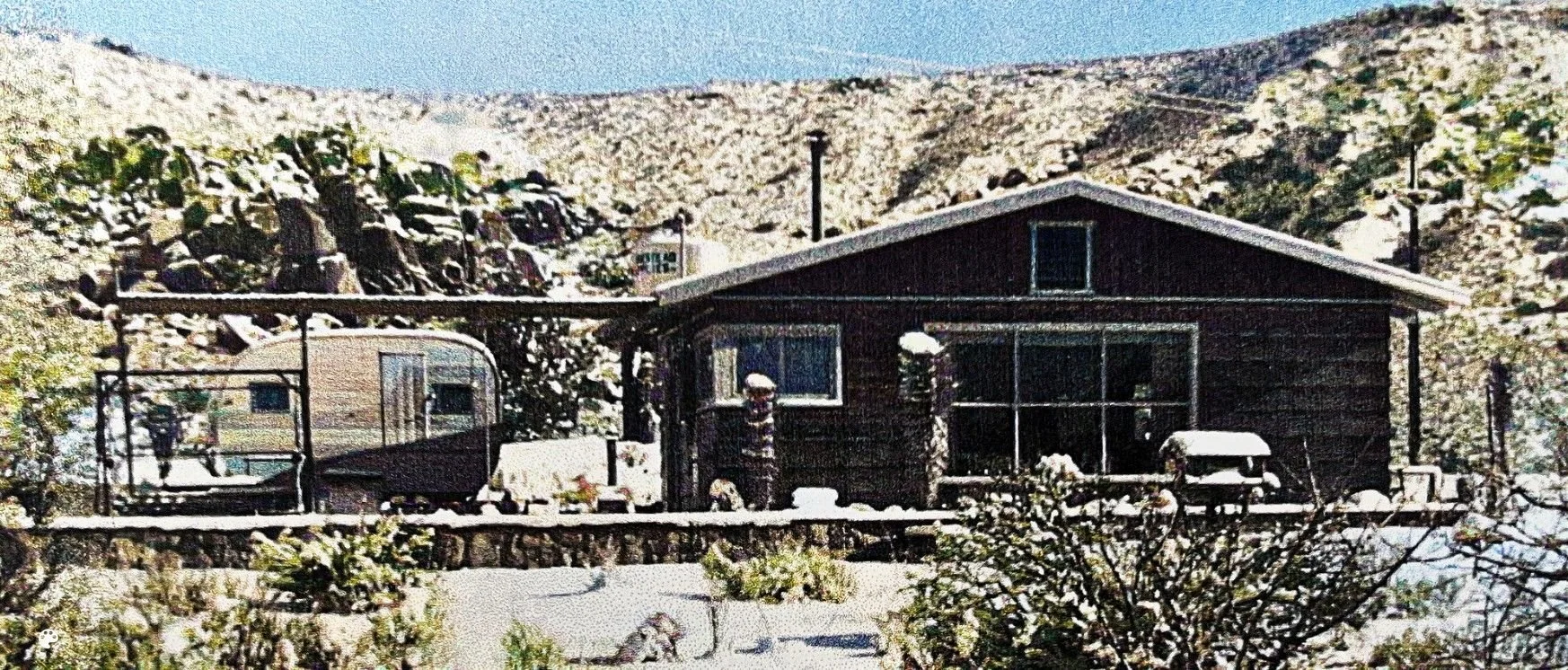
They became avid travelers, especially after acquiring a Dalton travel trailer, all over the western states from the Pacific coast to the Rocky Mountains and from the Canadian border to the Mexican border. One of their favorite places to camp was at the Jumbo Rocks campground in what was then Joshua Tree National Monument and they decided to search for property in the area. They started looking in Twentynine Palms and worked their way west. Nothing appealed to them. They were looking for suitable property that would provide what they wanted: boulders, Joshua Trees, junipers, wildlife and mountain views – nothing to do with square footage. Finally, they were shown a two-and-a-half-acre property with a cabin in Pipe’s Canyon. They immediately knew this was where they wanted to live.
Evelyn Grace Conklin never lost her love of nature. Even in her nineties, she would put out water and seed for the many birds around the house. She had a special connection with all creatures. She was so smart, yet very humble and was a very precious and lovely soul, and we will miss her dearly.
On display @ the museum:
“Conklin’s Camper”
1956 Dalton Travel Trailer
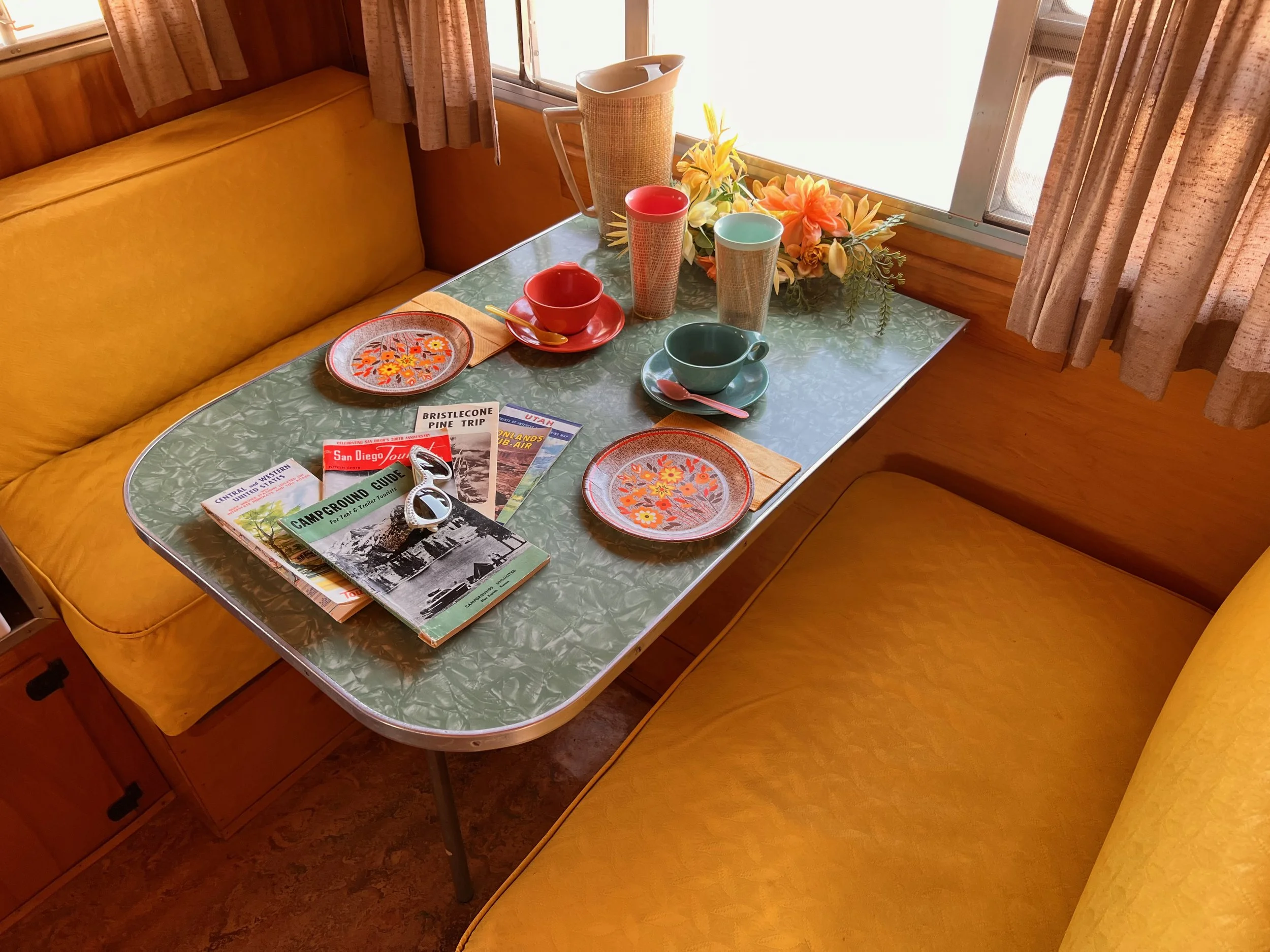
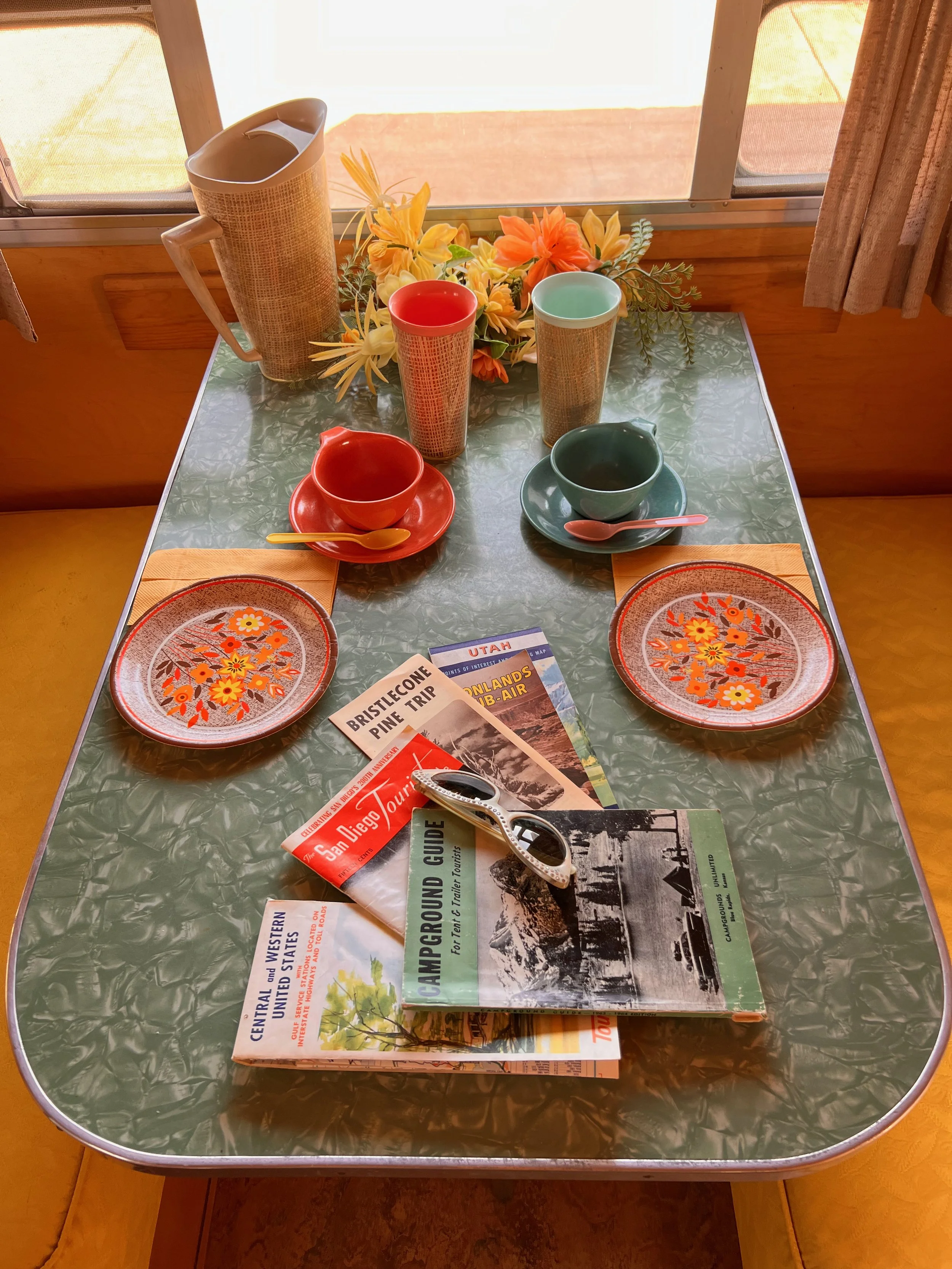
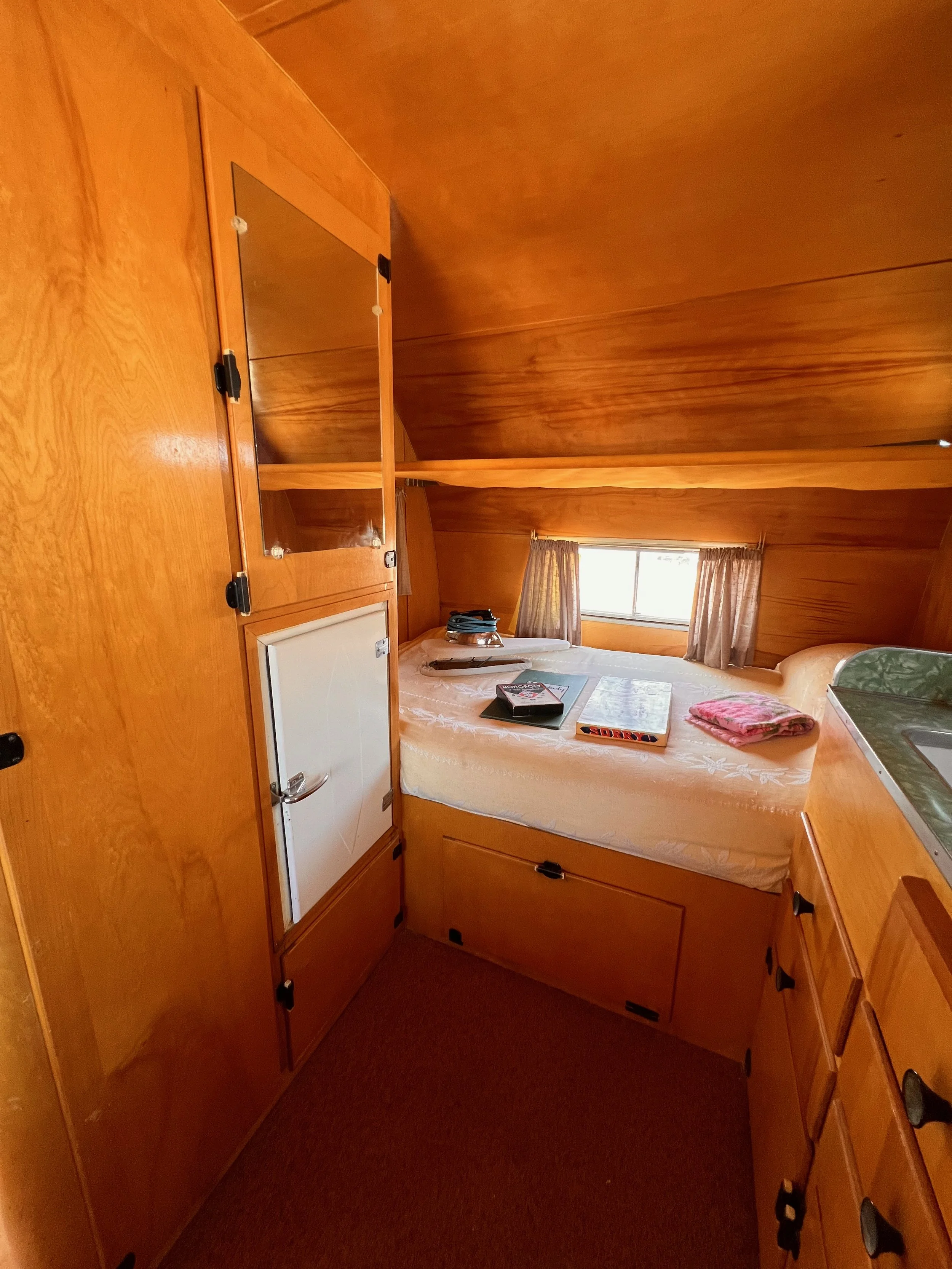
This Dalton travel trailer was donated to the Morongo Basin Historical Society by member Evelyn Conklin, a founder and the first naturalist and curator of the Hi-Desert Nature Museum in Yucca Valley. Evelyn and her father, Percy “Slim” Conklin, made many contributions to the culture and life of Yucca Valley and the Morongo Basin—indeed, to all of Southern California. We are grateful to have their vintage trailer, which traveled throughout the western United States, as an exhibit in their honor.
In 1956, while living in San Dimas and working for Los Angeles Parks and Recreation, Evelyn and her father decided to look for a travel trailer to use for their vacations. Such trailers were becoming increasingly popular, and they thought it would be an ideal solution—getting away while always having a place to eat and sleep, a true “home away from home.”
They had $1,000 that Evelyn had saved and visited a Dalton dealership in Pomona, not far from El Monte, where the trailers were built from 1955 to 1961. The salesman asked how much they wanted to spend, and when they told him $1,000, he mentioned a demo trailer he was willing to sell for that amount. They took one look and were delighted to see it was yellow—Slim’s favorite color. Without hesitation, they agreed to buy it and promised to return with the money.
The Conklins stocked the trailer with cooking utensils, supplies, and food before hitting the road each year from June to October, traveling all over the West. They had many adventures, yet in all those years, they only had one flat tire. Once, out of money and nearly out of gas, they had to drive up a mountain road to a post office to pick up Slim’s monthly payroll check. With their gas tank almost empty, they coasted down the mountain to the nearest gas station to fill up.
Evelyn was always searching for specimens for the Hi-Desert Nature Museum. On one occasion, at a National Park, she convinced a ranger to give her a king snake to bring back to the museum. However, soon after placing the snake in its cage inside the trailer, it escaped and disappeared. They searched everywhere but couldn’t find it, making for an uneasy night’s sleep as they worried about waking up with a king snake in bed. Much to their relief, the snake finally reappeared, and they successfully delivered it to its new home at the museum.